Azov
- Country:
- Russia, Azov
- Site:
- ***************************
To open the stars you need to log in
To open the stars you need to log in
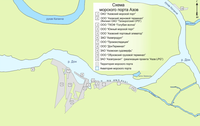
The commercial sea port of Azov is a large complex with an annual transshipment volume of up to 2 million tons. It is located in a wide Don estuary near the confluence with the Sea of Azov and provides cargo and passenger ships to the transport highways of the Mediterranean and Balkan-Danube transport systems. Since the mid-90s of the 20th century, the port of the city of Azov has become international and therefore has the right, as well as all technical capabilities to receive Russian and foreign ships of various displacement.
History of the formation of the seaport of Azov
The first mentions of Azov, as a sea port, are associated with the seizure of the fortress of the same name from the Turks in the late 17th century during the reign of Peter the Great. But in fact, this fortress has been almost 1000 years old. At the time of the entry of this territory into the Golden Horde of Azov, which was then called Azak, became a craft and trade center. And around the 14th century, seagoing vessels from all over the world had already begun mooring in its harbor.
During its history, the Azov fortress has repeatedly replaced its owners. So, for example, in 1637, the Don Cossacks unexpectedly for everyone were able to capture and for a long time deter it from the attempts of the Ottoman Empire to return this strategically important object. But the Russian tsar, to whom the Cossacks presented the captured fortress as a gift, decided not to aggravate relations with Turkey and returned Azov to the sultan.
Under Peter I, Azov received the status of a provincial city, but after that the city, and with it a convenient access to the sea, passed to the Turks 2 more times. And only in 1769 Azov finally became a Russian port. The rulers of the Russian Empire understood the importance of Azov as an important point on the way to transport goods from the north of the country to its southern borders and further abroad.
In 1865, to ensure the ability to receive larger ships, they began to deepen the Azov Canal, which is about 40 km long. And in the late 80s of the 19th century, the port acquired its own stone embankment. The official history of the port of Azov dates back to September 27, 1904, when it was decided to establish the port administration. Its main task was to restore order in cargo transportation. Then the main cargoes passing through Azov were grain, dried fish and, of course, caviar.
In the future, other commercial cargo began to pass through this port: sand, forest, metals. During the 20th century, the seaport of Azov became a gateway through which cargo from the rivers of the northern part of the country reaches the system of internal rivers and canals to the southern regions, as well as to Europe and Asia. In addition, this port, using passenger flights, connected almost all cities in the south of Russia into a single network. Comfortable and fast hydrofoils could take passengers to Rostov-on-Don, Taganrog and other cities with access to navigable rivers or the sea coast.
With the collapse of the Soviet Union, the structure of the Port of Azov underwent some changes, but it retained its status as a strategically important facility for the country's economy. In 1992, it was withdrawn from the Volga-Don Shipping Company, and in 1993 it was reorganized into a joint-stock company. And after the decision of the government of the Russian Federation since 1994, he began to accept foreign courts.
In 1997, the company received the prestigious European Golden Mercury Award for success in development and high performance indicators. In 1999, the Port of Azov received another prestigious international award in the nomination "For Dynamics and Progress in Economic Development."
Characteristics of the Port of Azov
Now the commercial areas and production facilities of the Port of Azov allow receiving up to 5 million tons of various cargo annually. The main items of freight transportation remain coal, iron, building materials, wood, grain, fertilizers. Since it is international, a customs post and other services relying in this case operate on the territory of the port of Azov.
According to information from the official website of the port of Azov, there are 11 berths in its water area, depths near them range from 4.5 to 8.5 m. The width of the river in the area of port berths is 400 m. The depth of the passage channel is 4 m. Open and closed storage areas with a total capacity of up to 1 million tons are also equipped on the territory of the Azov seaport. The total carrying capacity of simultaneously received ships can reach 5 thousand tons.
Also an important part of the economic success of the port of Azov is the availability of convenient entrances for road and railway transport. All necessary infrastructure is provided for receiving and sending cargo by land routes. On the territory of the port there are two car scales with a carrying capacity of up to 60 tons and electronic railway scales, with a measurement limit of up to 100 tons.
Due to its convenient location and properly functioning infrastructure, the sea port of Azov has every opportunity to organize transshipment of a large volume of cargo, servicing passenger traffic using sea and river transport. Through the harbor of the Port of Azov along rivers and seas, our country is connected not only with nearby European countries, but also with the states of Asia, North Africa, the Middle East.
FSBI ILA of the Sea of Azov in Azov
Address: 346780, Rostov Region, Azov, 14 Engels St.
Tel.: + 7 (86342) 5-20-26
Fax: + 7 (86342) 5-20-26
E-mail: azov@azov.ampt.ru